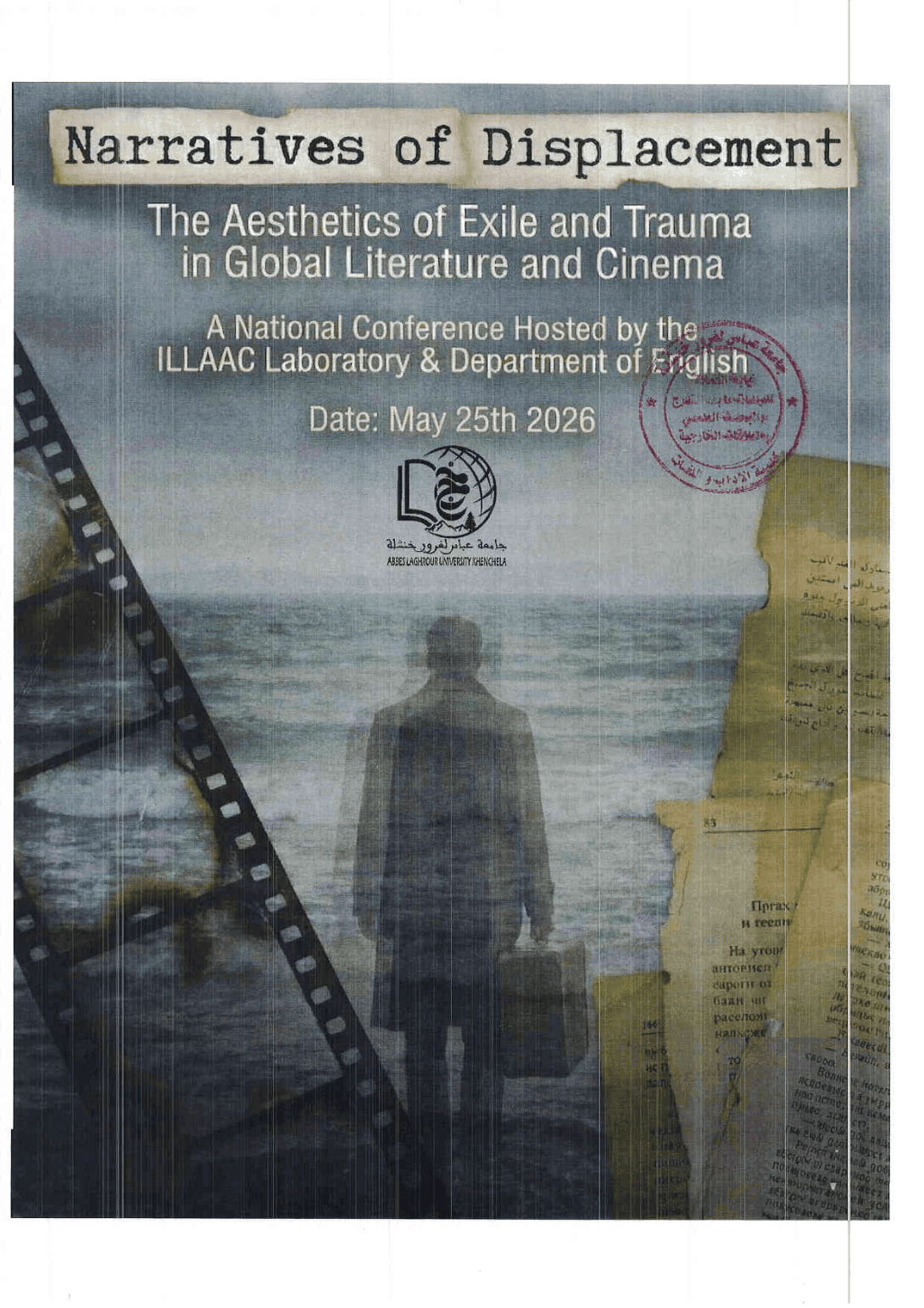
Narratives of Displacement: A National Conference on the Aesthetics of Exile and Trauma
À propos de l'événement
Narratives of Displacement: A National Conference on the Aesthetics of Exile and Trauma Abbas Laghrour University, Khenchela — May 25th, 2026 Introduction: When the Academy Confronts the World’s Open Wounds In an era defined by unprecedented human mobility — forced migrations, political exiles, and ecological displacements — the ILLAAC Laboratory and the Department of English at Abbas Laghrour University in Khenchela are staging a timely and intellectually courageous academic event. On May 25th, 2026, scholars, researchers, and practitioners from across Algeria will converge for the national conference « Narratives of Displacement: The Aesthetics of Exile and Trauma in Global Literature and Cinema » — a gathering that promises to be far more than a routine academic exercise. This conference does not merely study displacement from a safe intellectual distance. It asks the harder questions: How do literature and cinema transform unspeakable suffering into meaningful narrative? How do artists and filmmakers bear ethical witness to trauma without commodifying it? And what does it mean, in 2026, to tell the story of the dispossessed? The Central Question: Beyond Documentation The conference’s call for papers opens with a striking observation: displacement is not simply a geopolitical phenomenon but a fundamental rupture in the human relationship to space, identity, and memory. Invoking Edward Said’s characterization of exile as a « discontinuous state of being, » the organizers frame their inquiry around a crucial distinction — the difference between documenting the refugee or exilic experience and actively constructing an aesthetics of displacement. This is the intellectual heart of the conference: the argument that literature and cinema do not passively reflect displacement but actively shape how societies understand, respond to, and sometimes exploit the condition of the uprooted. Authors and filmmakers, in this view, are not neutral observers but active participants in the cultural politics of belonging and exclusion. Visual media and written narratives, the call for papers argues, carry unique capacities to challenge dominant ideologies of borders and belonging. Cinematic techniques — framing, montage, documentary realism — offer visceral encounters with forced migration, while literary forms navigate the psychological terrain of what Homi K. Bhabha famously called the « unhomely »: that disorienting space where domestic safety collapses and the boundary between the familiar and the foreign dissolves. Five Conference Tracks: A Panoramic Intellectual Framework What makes this conference particularly ambitious is the breadth and sophistication of its thematic architecture, organized across five distinct yet interconnected tracks. Track 1: Cinematic Cartographies, Media, and Propaganda addresses perhaps the most politically urgent dimension of displacement representation. It examines the ethical boundaries between documentary truth and fictionalized trauma, analyzes how xenophobic border policies are visually engineered through media, and — crucially — explores « counter-gaze cinema »: filmmaking by refugees and exiles themselves that subverts dominant narratives and reclaims agency. The use of archival silences and found footage to reconstruct erased histories adds a methodological richness to this track that bridges cinema studies and memory studies. Track 2: The Literature of Trauma and the « Unclaimed Experience » delves into the formal and psychological dimensions of exile writing. It examines the literary techniques — fragmentation, non-linear timelines, polyphony — that writers deploy to capture the belatedness and shock of trauma. Particularly compelling is the focus on the « linguistic burden of exile »: the politics of translation, the loss of the mother tongue, and the complex act of telling an exilic story in the colonizer’s or the host country’s language. The track also addresses post-memory and generational trauma, exploring how the children of exiles narrate a displacement they inherited but never physically experienced — a phenomenon of growing relevance in an age of second and third-generation diasporic communities. Track 3: Digital Diasporas and Technological Borders brings the conference firmly into the twenty-first century. It investigates how displaced individuals use social media platforms to narrate their journeys in real-time, transforming Instagram feeds and Twitter threads into archives of lived experience. More critically, it examines the darker side of digitization: surveillance technology, biometric borders, and the role of artificial intelligence in « policing displaced bodies. » The concept of « open source memory » — the use of digital humanities tools and collaborative databases to preserve indigenous and exilic histories — offers a hopeful counter-narrative to digital dispossession. Track 4: Decoloniality and Global South Perspectives is perhaps the most theoretically ambitiou
Site web de l'événementAutres événements
D'autres rendez-vous à travers l'Algérie